Cost-Effective Solution for Beverage Mixing Cocktails
As consumer tastes in the beverage industry keep shifting, the pressure is on for existing breweries, creators of infused and functional beverages, and emerging start-ups to adopt cost-efficient strategies to launch products swiftly. This white paper outlines the advantages of using side entry agitators in glycol-jacketed brite tanks, which are proven to be highly effective for beverage mixing and blending. It also touches on the best practices for packaging these beverages for the retail market and wider distribution.
Maintaining Product Quality
In the dynamic world of beverage production, the secret to maintaining impeccable product quality lies in the consistency of your mixing and blending processes. Through our sophisticated equipment and advanced configurations, we provide a roadmap to achieving that much-sought-after uniformity in both taste and texture, paving the way for superior end products that beckon to be savored.
Glycol-jacketed stainless steel brite tanks embody this commitment. Expertly crafted for carbonation and conditioning, these vessels are integral to achieving a final product that resonates with quality and consistency. Agitation is necessary for achieving uniform mixtures and even temperature distribution during the mixing process. Side entry agitators present a technically superior solution due to their unique design and configuration. Once the final product is ready, manufacturers must quickly get the product to its final packaging to maintain quality. Canning machines are the leading packaging system in the craft beverage industry due to their compact footprint, ease of use, and utilization of aluminum cans over glass or plastic.
Design and Operational Benefits of Side Entry Agitators:
- Compact Design: Side entry agitators are compact, reducing overall tank height requirements and allowing for efficient use of vertical space.
- Maintenance Accessibility: Easier access for maintenance and cleaning since the agitator is mounted on the side rather than the top, eliminating the need to climb onto tanks.
- Axial Flow Dynamics: The impeller design creates axial flow patterns, enabling rapid and uniform mixing of ingredients, additives, or carbonation gases throughout the tank.
- Reduced Vortex Formation: The horizontal orientation minimizes vortex formation, ensuring consistent mixing even at higher agitation speeds.
- Pressurized Vessels: tri-clap side entry for agitators allows the product to be held under pressure while top mount systems do not.
- Lower Power Consumption: Due to improved hydrodynamics, side-entry agitators require less power than top-mounted mixers to achieve the same mixing intensity.
- Product Integrity: Gentle mixing reduces shear stress on delicate beverage ingredients (e.g., fruit puree, hop oils), preserving product integrity and desired texture.
Process Benefits in Beverage Mixing and Blending:
- Uniform Ingredient Distribution: Consistent circulation ensures even distribution of added ingredients, preventing stratification or settling.
- Carbonation Efficiency: Effective dispersion of CO2 or nitrogen gases creates a uniformly carbonated or nitrogenated beverage.
- Thermal Homogeneity: Continuous mixing promotes uniform temperature distribution, reducing the risk of hot or cold spots that could affect yeast fermentation or carbonation.
- Cooling and Heating Efficiency: Accelerated heat transfer due to agitation speeds up the conditioning process, reducing overall production time.
- Improved Yield: Precise control over mixing parameters minimizes product loss due to over- or under-carbonation, ensuring consistent quality.
Comparison with Other Mixing Systems
- Limitations: Top-entry agitators often require taller tanks and consume more energy due to inefficient flow patterns. Vortex formation is more pronounced.
- Pressurization: Top entry agitators are not air-tight and do not allow for the product to be held under pressure in the tank.
- Drawbacks: Bottom-entry agitators may pose cleaning and maintenance challenges and increase the risk of sediment buildup. The vertical flow pattern may not be suitable for all beverage types.
Packaging your Final Product:
An increasing number of beverage producers are moving to aluminum cans as the preferred choice in packaging for retail sales and distribution. In addition, the compact nature, ease of use for canning machines, and recyclability of cans make this a more cost-efficient and sustainable alternative to glass and plastic packaging.
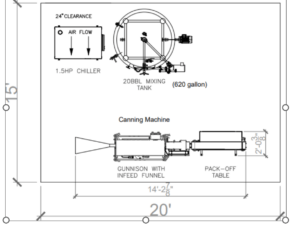
- Machinery Footprint: In-line canning systems that are roughly 3 feet wide by 15 feet long including the infeed, filling system, can sealing, and pack-off area can produce up to 30 cans per minute.
- Versatility: Canning machines can accommodate various beverage types, including carbonated drinks, infused beverages, craft beers, juices, RTDs, seltzers, and more.
- Sustainability: Aluminum cans are highly recyclable and have a smaller environmental footprint compared to glass and plastic bottles.
- Consumer Appeal: Many consumers prefer products with sustainable packaging, enhancing your brand’s appeal.
- Portability: Cans are more portable and convenient for consumers, especially for outdoor activities and events.
Bringing it all Together:
If you’re interested in getting started with new beverage production or looking to add additional capabilities to your existing operations, a small-scale mixing and canning system costs less than $100,000. When you consider the benefits of side entry agitators for mixing alongside a compact canning system, you have a winning combination for creating craft beverages that complement any existing operation. Key components and pricing:
- Glycol Chiller: Important to keep the product cool during the mixing process and a small system is less than $9,000.
- 620-gallon Jacketed Mixing Tank: For proper mixing and process control a stainless brite tank with glycol jacket, side entry agitator, temperature control, valve, and piping cost around $21,000.
- Transfer Pump Cart: Used for transferring the final product from the tank to the canning machine and is less than $4,000.
- Gunnison Canning Machine: This complete system includes a can infeed, flip and rinse, filling, sealing and pack off station for under $65,000 and runs on a standard 120V dedicated circuit.
Sample System Layout:
Contact Us Now to Explore Options
References:
-
- Doe, J. et al. (2021). Efficient Mixing Techniques in Beverage Production. Journal of Food Engineering, 130(5), 101-108.
- Smith, A. & Brown, R. (2019). Advanced Agitation Systems in Stainless Steel Brite Tanks. Beverage Science Review, 45(3), 67-75.
- Jones, P. & White, S. (2023). Energy Optimization in Beverage Agitation Processes. Process Engineering Quarterly, 18(2), 42-58.